Posted by Marc Hodak on October 2, 2007 under Collectivist instinct | 
“We tell the government, ‘Take what you want, just give me and my family the essentials of life — food, shelter and an education,'”
– Egyptian union activist in a recent article about unrest in that country.
Contrast this with:
“Any society that would give up a little liberty to gain a little security will deserve neither and lose both.”
– Benjamin Franklin
Posted by Marc Hodak on under Practical definitions |
Illegal labor. What an ugly term.
Definition: I want to work for you. You want me to work for you. Someone else gets to say: “Too bad.”
That someone else very likely has zero interest in this proposed transaction; they just don’t want me to work for you. They will call me “illegal” because they can, and use that as an excuse to stop us from agreeing to help each other out.
Or that someone else might have some pie-in-the-sky, stupid-ass reason for wanting me to not be able to work. They might belong to some organization called Californians for Population Stabilization. This organization actually says that there are “too many people.” Yes. In a state with one of the lowest population densities in a largely unpopulated country. If this sounds disingenuous, that’s because it is.
Californians for Population Stabilization, like most organizations using the term “illegal labor,” is actually a front for the unions. Unions are deathly afraid of anyone possessing two hands and a brain because such persons represent labor competition. Unions would like all labor competition to be banned. This reflects a profound ignorance about the nature of an economy, that it’s a fixed-pie, zero-sum game. It ignores that those hands are attached to a mouth, and that brain contains aspirations. In other words, a working human being creates at least as much demand for labor as supply.
Thus, labeling certain people as “illegal,” intended to undermine their ability to support themselves, actually undermines their potential as sources of jobs for others. We’re used to unions engaging in self-destructive behavior by undermining the companies and industries they dominate. At least in those cases, some existing workers get a temporary benefit from bleeding their companies, even if it eventually undermines their jobs. But why should we put up with union attempts to keep other people from working for everyone’s benefit?
Posted by Marc Hodak on September 28, 2007 under Collectivist instinct |

While people in advanced countries initiate mass protests over the possibility of a company being able to fire an employee, or equate WalMart’s employment practices with human rights abuses, or call the toe-tapping of a confused Senator a national scandal, it kind of returns some perspective to watch the military leaders of a country like Myanmar draw the blinds on it’s nation and begin a rampage of intimidation and murder against its own people.
The moral equivalence of the latter event with the former is part of the deconstruction of Western civilization, like the notion of economic violence used to describe consenting adults making informed choices for mutual economic gain. Notwithstanding that deconstruction, the West is at least leaving behind the practice of mass violence against its own people, while the junta in Myanmar shows us the most vivid example of coercion, revealing the essence of government.
Of of the few virtues of democracy is that it at least diffuses government power; tyranny of the majority is slightly better than tyranny of a ruling family. So, like Churchill, I’m far from a fan of democracy, but I’m happy when the klieg lights shine upon cynical, arrogant rulers trying to have their way with unarmed civilians, monks no less, simply because they can. The bright lights make them stop and hide their faces, at least for a moment. The Burmese generals are desperately trying to keep that light from shining in their dark corner of the world. But it’s too late. Their legitimacy is gone. All that is left is their brute force, and there aren’t enough guns to stop the rise of a people against a government that has lost the sanction of its victims.
Posted by Marc Hodak on September 27, 2007 under Revealed preference |
This from a public official:
I firmly believe and am confident of the fact that had it not been for the direct intervention of the Lord Jesus Christ last Thursday, a disaster would have happened. You can quote me on that.
This is the Jena, Louisiana DA’s explanation of why the protests against his arguably selective prosecution of black youths remained peaceful.
The DA and his supporters were trying to make the case that he is not a racist. I don’t know. And given what I know about how the press covers such things, I’m inclined not to believe that the DA is channeling old George Wallace. But that defense becomes a bit strained when this DA has looked out on the massive protests against his prosecution
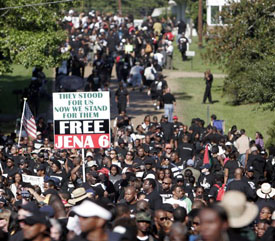
and concluded that peace was maintained only because Jesus put his calming white hand upon their black hearts. What else could it be? I mean, is it conceivable that a large black group could have possibly maintained peace on their own?
Posted by Marc Hodak on under Collectivist instinct |
It sounds like a joke:
A rabbi, a Roman Catholic priest and a Baptist minister joined Senate Democrats in making a moral argument for the legislation.
The legislation in question is SCHIP, the Children’s Health Insurance Program.
While most people who aren’t Democrats or Republicans would say the two parties are barely distinguishable, I would say that when it comes to spending, nearly all Democrats are focused on the worthiness of the end, while many Republicans are concerned about the process.
Typical Democrat take:
“In St. Luke’s Gospel, we are told that Jesus instructed his disciples to ‘let the little children come unto me, and do not hinder them,’” said Senator Edward M. Kennedy, Democrat of Massachusetts. “We urge Congress and the president to support our bipartisan legislation and let little children have health care.”
This looks like generosity, but it’s generosity with other people’s money. (It’s also a lie, since most of the recipients of this new bill already have health care. Isn’t lying immoral?) Typical Republican take:
Senator John Ensign of Nevada, chairman of the campaign committee for Senate Republicans, denounced the bill as “a step toward the Democrats’ ultimate goal of a single-payer, government-run health care system.”
This looks like a concern about process, but it’s easy to interpret as lack of compassion. So there is always a Republican who will play to the Democrats’ gallery:
Senator Orrin G. Hatch, Republican of Utah, responded [to Ensign]: “That’s a nice, sweet, cute little argument, but it does not solve the problem of how you help these kids. I am not about to allow these children to go without health care.”
which is where the Republicrat charge arises. Helping the children is great populism, but it’s nearly always tied to a disingenuous policy when you get into the details.
The easiest way to get enough people to agree to pay for a disingenuous policy is to promise enough people that the money won’t be spent too far from home:
The bill would increase the federal money available to every state next year.
So, a rabbi, a priest, and a minister agree that forcible redistribution of money for a dubious purpose in what will no doubt be the least efficient way possible is the moral thing to do. What a joke.
Posted by Marc Hodak on September 23, 2007 under Scandal |
Whenever I get down to Maryland, I’m re-exposed to the WaPo, often to my dismay at how a scandal sheet looks dressed up as a respectable paper. This morning, I was pleasantly surprised when I saw this story. Key paragraphs:
Congress passed a law, triggering a little-noticed worldwide war on human trafficking that began at the end of the Clinton administration and is now a top Bush administration priority. As part of the fight, President Bush has blanketed the nation with 42 Justice Department task forces and spent more than $150 million — all to find and help the estimated hundreds of thousands of victims of forced prostitution or labor in the United States.
But the government couldn’t find them. Not in this country.
You and I might be embarrassed to cry wolf, only to lead the town to an empty field. But not so those who benefited from making a Federal case out of what, in nearly every instance, turned out to be ordinary pimping. One of Bush’s moral crusaders drawing his ludicrously over-sized sword:
Tony Fratto, deputy White House press secretary, said that the issue is “not about the numbers. It’s really about the crime and how horrific it is…
“We have an obligation to set an example for the rest of the world, so if we have this global initiative to stop human trafficking and slavery, how can we tolerate even a minimal number within our own borders?”
Here’s how GloboCop: spend maybe $2 or $3 million to see how much of a difference you can make, before ramping up to a frenzied enforcement effort–not $150 million.
It may sound kinda cheap to argue that so much tax money shouldn’t be wasted on virtually non-existent problems if they exist at all. But I’m constantly mindful that those taxes were coerced away from us. We worked for it, and it went to someone else. By threat of violence. $150 million. How much forced labor does that represent?
Posted by Marc Hodak on September 19, 2007 under Revealed preference |
A couple days ago, Don Surber wrote a great piece on the return on investment in lobbying Congress.
You bought Google at $100 and 3 years later is nearing $600 a share? Big deal. Microsoft has gone up 28-fold over the last 20 years? Yawn. You want to make the big bucks? Rent a congressman. Your return on your investment can be as high as $75 for every dollar invested.
Well, being the smart guys they are, Google has caught on quickly.
Internet search company Google Inc. has registered in-house lobbyists for the first time since establishing a Washington office in 2005.
“We’ve expanded our presence because there are an increasing number of issues being debated in Washington that are of concern to our users,” said Adam Kovacevich, a spokesman for Google, which spent $580,000 in first six months of 2007 to lobby the federal government.
That’s $100,000 per month that will go to a lawyer instead of an engineer.
Is this a great country or what?
Posted by Marc Hodak on September 17, 2007 under History |

Today in 1787, the delegates at the Constitutional Convention in Philadelphia put their names to their new creation. The Constitution was a remarkable document in several ways. First, it’s short. At 5,000 words, it may be the shortest national constitution ever written. Our Founding Fathers understood the virtue of keeping it simple. People have to understand the rules if they are to accept them, let alone abide by them.
In contrast, the proposed E.U. constitution was about 150,000 words. Few understood it what it actually said. Its length and jargon was an insult to a free and educated people. It went down in flames. I’d like to think that the example of our short, relatively transparent document was partly responsible for that.
Much of our Constitution’s power came from its support by a literate, propertied class upholding a heritage of personal and economic freedom. If it had been drafted outside of this context of the highly evolved social institutions it sought to support, the Constitution would have likely have ended up as merely 5,000 words on a piece of paper. Consider this cheap imitation:
The Constitution guarantees all Frenchmen equality, liberty, security, property, public debt, freedom of worship, public schooling, public relief, unrestricted freedom of the press, the right to assemble in groups, and the enjoyment of all the rights of man.
But it’s difficult to take these words seriously as they were written at the onset of the Reign of Terror, where the state proceeded to murder 40,000 Frenchmen for things as simple as hoarding food or not showing enough revolutionary ardor in trials that could only yield verdicts of acquittal or death.
Or consider this phrase from another constitution:
In conformity with the interests of the working people, and in order to strengthen the socialist system, the citizens of the U.S.S.R. are guaranteed by law: 1. freedom of speech; 2. freedom of the press; 3. freedom of assembly, including the holding of mass meetings; 4. freedom of street processions and demonstrations.
The only people who believed these words meant anything were certain naive Americans like Franklin Roosevelt, who very well may not have known that Uncle Joe was murdering tens of millions of his own people at the time even as he wrote those words.
Of course, the greatest thing about our constitution is that, despite its flaws and its reliance on highly imperfect people and institutions, it works. In the end, it delivers a government that is pretty much what the people want.
Posted by Marc Hodak on September 15, 2007 under Revealed preference |
OK, here is my proposal to alleviate the organ transplant shortage: If you want to be the recipient of an organ transplant at some point in your life, you have to register somewhere as an organ donor, something as simple as checking off the box on your license, before you need an organ.
This is admittedly a proposal born of very little study on my part–you could fairly call it ignorance. I don’t know what percentage of people have checked off the organ donor box versus not. I don’t know how many potential donors’ organs go unharvested because they didn’t check off the box vs. the total need for human organs. I don’t know if we want to create a constituency that is indifferent to improved auto safety. But it seems to me that many people don’t check off the organ donor box because of a combination of the “ick” factor and laziness. In other words, for silly reasons that could be easily overcome with a little incentive.
I also understand that certain people can’t check off the box for religious reasons, thus likely placing those people below the line when it comes time for a transplant. I count my closest, dearest family members among this group. Screw em. If their religious beliefs take then out of the pool of donors, it should take them out of the pool of recipients, and leave the rest to God’s will.
Seriously, I would be happy to give my brother one of my kidneys should he ever need one. But my heart, when I no longer need mine, should go to someone who placed theirs at risk of being at my disposal. I think that’s as fair as inherently unfair circumstances can be.
Posted by Marc Hodak on September 11, 2007 under Self-promotion |

My new paper is up on SSRN! This is the cool case of Ford v. Dodge (the famous 1919 legal case is only part of the whole, sordid story). This fully-sourced presentation is for my “History of Scandal” class opening this semester, where I’m teaching about the evolution of corporate governance in the U.S.
If you’re into business history with a legal twist, you will enjoy this case. I was hoping to get six cases up before the class started, but reality intrudes. I’ll be lucky to have three up by the middle of the semester. I made a slight revision to my other case already up on SSRN, The Enron Scandal, which was the #5 most downloaded new paper in the Management Research Network this summer.
I’m still promising an awesome class, but the rest of the class material just won’t look as finished as I would have hoped.
The “Ford Squeeze-out” abstract appears below the fold!
Read more of this article »
