Posted by Marc Hodak on August 4, 2009 under Collectivist instinct, Executive compensation | 
Lucian Bebchuk is editorializing on compensation regulations again, proposing that bank compensation is too important to be left to the banks (or, more precisely, to their boards). Like any good debater, he attempts to address the objections put forth by critics of his position. I think he kind of stumbles on this one, though:
Furthermore, limiting structures that incentivise risk-taking is not more demanding in terms of information than regulators’ traditional intervention in investment, lending and capital decisions.
Not exactly a confidence booster, huh? (I’m visualizing the smart guys in Basel grinning nervously, asking, “Hey, what could go wrong?”)
Look, Bebchuk offers perhaps the best defense of certain proposed compensation regulations around. He is thorough, insightful, and moderate by the standards of current political discourse. In this case, he is not relying on his mistaken managerial power thesis to defend what he describes as a problem of externalities. But in the end, he makes the same error in assuming that developing optimal pay structures is something that anyone can do if they just think about it hard enough.
Developing good compensation mechanisms is not an exercise for amateurs. Even the experts get it wrong when they are acting in good faith. To expect a regulator, or any non-interested third-party to develop optimal compensation contracts for both the firm and society is like asking a committee of lawyers to develop a surgical strategy for treating leukemia; you know there’s a problem there, but it assumes the people you’re asking to solve it know what the right questions are, let alone the right answers.
I say, let the regulators show that they can regulate investment, lending and capital decisions–which at least have a basic theoretical ground of common understanding–before unleashing them on incentives, which can multiply the effects of unintended consequences.
Posted by Marc Hodak on July 30, 2009 under Executive compensation, Reporting on pay |
Andrew Cuomo, Attorney General and Chief Compensation Scold of New York, raises his pitchfork once again with a report “No Rhyme or Reason,” condemning Wall Street’s “bonus culture.” The most damning piece of evidence?
Bonuses paid to executives at nine banks that received U.S. government bailout money in 2008 were greater than net income at some of the banks.
This is only surprising if you think of bonuses as something other than commissions based largely on net revenue, or perhaps net income from profitable divisions that likely saved their firms from bankruptcy.
The WSJ offers this puzzling assessment of the report:
The report is part of Cuomo’s investigation into the causes of the financial crisis. Not surprisingly, that investigation led to Cuomo’s office examining the compensation practices in the U.S. banking system.
Not surprisingly? The reason Cuomo’s investigation into compensation is not surprising is because he’s obsessed with Wall Street pay. A Cuomo investigation into the mating habits of pigeons would have led him to a critique of bank bonuses. In fact, Cuomo’s report does not even pretend to provide the slightest link between compensation practices and the financial crisis. I’m not saying there is no linkage to be made; this report simply provides none.
Read more of this article »
Posted by Marc Hodak on under Collectivist instinct, Executive compensation |
Well, we have Barney Frank:
You get hired for this very prestigious job and you get a salary, and now we have to give you extra money for you to do your job right?
This puts Mr. Frank to the left of Albert Shanker, militant union leader of the United Federation of Teachers, and Nikita Khruschev, leader of the Soviet Communist Party.
His use of “we” might be viewed as a sense of financial services companies under TARP being an arm of the U.S. government. But in the context of his proposing to expand compensation regulation to non-TARP firms, “we” can only be interpreted as evidence of his collectivist mindset, as if the bonuses paid to executives comes from the public at-large.
Posted by Marc Hodak on July 29, 2009 under Executive compensation, Practical definitions, Reporting on pay |
Congress is trying the belt and suspenders approach to keep the market from having another meltdown as we experienced last year. The belt is tighter controls at TBTF firms. The suspenders are the elimination of perverse incentives.
The thing is, if you want to eliminate perverse incentives, you have to know what they look like. According to an Equilar survey, here are some of the questions that companies are considering as they examine issues of excessive risk:
- Are we over using stock options?
- Do our incentive plans promote short-term thinking?
- Do we have the right mix between short and long-term goals?
- Do large maximum bonus opportunities promote risk taking?
- Are we using overly aggressive performance goals?
- Do our bonus plans focus on too narrow a set of goals?
- Do we have the right mix between fixed and variable compensation?
Six of these questions are sensible. One sticks out as completely bizarre to an incentive expert: “Do large maximum bonus opportunities promote risk taking?”
Of course they do. Is that supposed to be a bad thing? Entrepreneurs have unlimited bonus opportunities–thank goodness.
The question of a maximum bonus opportunity is simply the wrong question when talking about reward systems. The question they should be asking is whether steep bonus opportunities are combined with zero bonus opportunities. All the governance risk faced by a company is in the area where the participant would earn no bonuses unless they can get up into the green zone of bonus payouts with an all-or-nothing, double-down, longshot bet.
So, guess which of those questions most congressmen view as the most critical in determining “excessive compensation risk?” Yep, the risk that business executives might get paid too much.
Unfortunately, the reporting on the proposed regulation of compensation risk doesn’t even bother to define what “excessive risk” means at all, instead focusing on the political considerations of supporting or opposing any bill that purports to “contain” the excesses.
Posted by Marc Hodak on July 27, 2009 under Executive compensation, Politics, Reporting on pay |
This paragraph says it all:
With public anger high over the rich pay packages awarded to some financial executives, Mr. Feinberg must walk a fine line between curbing pay at companies benefiting from taxpayer funds while not squeezing compensation so hard that it hurts the ability of companies to lure talent.
Mr. Feinberg is nicknamed the “Pay Czar,” no doubt because the Czar was such an inspiration in making the right trade-offs between populist demands and economic needs.
The irony is that Feinberg’s grandparents, like my own, may very well have been folks who escaped the Czar’s anti-semitic pogroms in the early part of the last century. We wouldn’t dream of nicknaming to Feinberg an “Oberfuhrer.” Perhaps a Commissar, Sotto Capo, or Underboss might be just as good. If not, why do so many people consider a ‘czar’ such a desirable thing in a free country?
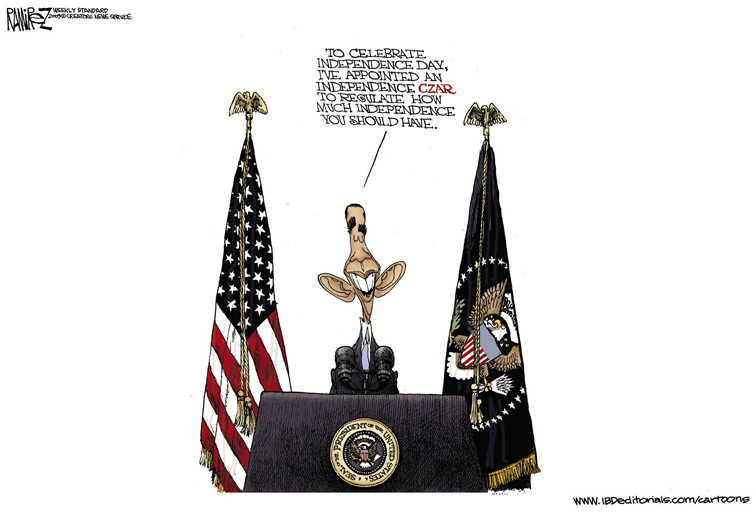
Sounds good to me
Other Michael Ramirez cartoons
HT: Mike Perry
Posted by Marc Hodak on July 25, 2009 under Executive compensation, Politics, Reporting on pay |
It appears that Citi is on the hook for $100 million to the head of their Phibro division.
A top Citigroup Inc. trader is pressing the financial giant to honor a 2009 pay package that could total $100 million, setting the stage for a potential showdown between Citi and the government’s new pay czar.
The New York Times and Wall Street Journal, who would consider it well beneath them to publish front page stories about Jennifer Aniston’s romantic travails, have no qualms regaling the mob with stories about big dollars going to unpopular executives–the MSM’s version of porn for the business pages, which they peddle in the brown paper bag of “governance issues.” The government is easily embarrassed by these big dollar stories, which sets up “the showdown.”
So, am I suggesting that Andrew Hall, the guy in line for this bonus, is worth $100 million a year? No, I’m not. I’m sure he neither needs or deserves this princely sum. I’m simply suggesting that he should get what his contract says he should get.
A former official recently told me, “hey, contracts get challenged and renegotiated on Wall Street all the time, so why are you so upset when the government is doing it?”
I’m not upset when the government does it the way private firms typically would. A Wall Street firm renegotiates contracts quietly, to avoid the perception that they take their agreements lightly. No bank, however “powerful” they may be, could keep their doors open a fortnight if they could not be counted on to keep their word on a deal.
In contrast, the government uses these public spectacles to flaunt its disrespect for contracts, standing in a champion’s pose before the cameras, ignorant or uncaring that their knock-out is a blow to the rule of law.
Read more of this article »
Posted by Marc Hodak on July 22, 2009 under Collectivist instinct, Executive compensation, Politics, Scandal |

Missouri state's HR department
The nice people at MOSERS, the Missouri state pension fund, had a bonus plan. They beat their targets, earning their bonus. The Governor and legislature denied them their bonus.
Governor Jay Nixon called $300,000 in bonus payments to the 14-member staff of the Missouri State Employees’ Retirement System (MOSERS) “unconscionable.”
Unconscionable? What happened?
MOSERS’ incentives are based on a five-year cycle. The bonus payments paid this year were based on fund performance from January 1, 2004, through December 31, 2008. In that period, says [Executive Director Gary] Findlay, MOSERS had an overall return of 3.9% compared with its benchmark of 1.8%. (the benchmark is the performance of the asset allocation if it were invested passively).
The difference to MOSERS between a 3.9% rate of return and a 1.8% rate of return over that period, points out Findlay, is $600 million. So, the MOSERS investment staff added $600 million in value to the fund’s assets for bonus payments of $300,000, which is 5/100 of 1%.
So, tell me again, why did the politicians hose the MOSERS fund managers?
[Chairman of the legislature’s pension committee, Senator Gary] Nodler argues that payment of bonuses makes no sense in any year in which the fund experiences no actual growth. When the fund loses money, he says, then there is no money from which to pay the bonuses except to go into current assets. And that, he says, is a misappropriation of funds and a breach of fiduciary responsibility.
Makes no sense, indeed.
I give Nodler points for creativity, however. I have never heard a “breach of fiduciary responsibility” allegation used to cover up a breach of contract and a breach of good faith. You have to have a highly cultivated sense of mendacity to make this stuff up while summoning outrage for the cameras.
If the politicians had a shred of integrity, they would have told their pension fund managers five years ago that they would under no circumstances get any bonuses when absolute returns were negative. That way, the managers could have evaluated their compensation fairly versus their other opportunities, and decided whether they wished to stay or take their talents elsewhere. Given that the pols agreed to a bonus plan, their ignorance of its terms, or difficulty in explaining to the public why they are making payouts, is not a reason to stiff their employees. At best, if they decided after the fact that they wanted to pay for absolute performance rather than relative performance, then they should recalculate the bonuses earned in past years under this plan on an absolute basis, and pay them consistently. As it stands, the Missouri politicians were content to pay bonuses based on relative performance when peer fund returns were positive, but for absolute returns when the funds are negative.
And that is why politically run systems can’t outperform private sector ones.
Posted by Marc Hodak on under Executive compensation, Invisible trade-offs |

The Sucker Proxy
While Congress presses ahead on “Say on Pay,” some institutional investors are beginning to rethink their position. The Say on Pay bill would require an up or down vote by investors each year for every public company. Even a small pension fund has investments in thousands of companies. How are they supposed to wade through the SEC-mandated morass that is executive compensation disclosure for every one of those companies sufficient to form an opinion on its adequacy and render a vote?
My firm plows through hundreds of proxies each year in order to determine the relative quality of compensation plans for our research purposes. We employ a team in India to get the data, and a couple of analysts in New York to plow through the data for a couple of months in order to reach opinions about specific firms. We’re down to doing this every other year because the effort is so costly, and the quality of plans don’t really change that much from year to year for any given firm.
Activist investors have sipped this tonic, and have come to a conclusion of their own:
Some shareholders say they have already gotten a taste of say on pay voting and find it unwieldy and time-consuming. The United Brotherhood of Carpenters, whose pension funds have about $40 billion in assets, says it cast more than 200 say-on-pay votes this year at companies participating in the government’s Troubled Asset Relief Program. These companies needed to get their pay plans ratified by shareholders…
“We think less is more,” said Edward Durkin, the union’s corporate affairs director. “Fewer votes and less often would allow us to put more resources toward intelligent analysis.”
Unfortunately, they’re making this case to congressmen who don’t even read the laws that they pass.
Posted by Marc Hodak on July 16, 2009 under Executive compensation, Reporting on pay |
Last year, Jamie Dimon and Lloyd Blankfein had a bad, bad year. They took it on the chin, and paid themselves no bonuses. Their JPM and GS colleagues collected little or nothing compared to earlier years, in some cases giving up millions that they might have legitimately earned based on their business units’ good performance in a tough year. In return, GS and JPM got…pilloried with their lesser rivals in the press as paragons of greed.
This year, it looks like GS and JPM are doing much better thank you. They will be increasing their pay accordingly. Members of Congress, once again, are in a tizzy.
“Recently reported bonus pools do suggest that there may be a return to the old ways which caused such damage to our economy. It reinforces our determination to adopt a reasonable set of legislative goals,” [Barney] Frank said.
This first sentence actually contains two false statements. First, the bonus pools don’t suggest anything, other than the fact that these two firms were quite profitable in the first half of 2009. Second, no evidence has ever been offered that JPM or GS did any damage to our economy. Of all the financial institution that were too big to fail, these two were farthest from failing and, in the case of JPM, saved a TBTF bank or two.
By the way, Members of Congress, including those on the finance committees directly overseeing Fanny and Freddie, suffered no diminution in pay in 2008. In fact, Barney Frank is taking in record amounts, including from the financial firms he is supposedly overseeing.
Read more of this article »
Posted by Marc Hodak on July 2, 2009 under Executive compensation |
Here is a sample of what it looks like they are considering:
– A written description of risks posed by their compensation policies
– Disclosure of potential conflicts in compensation consulting
– Disclosure of the market value of stock options at the time they are granted, instead of over the time period over which they are vested
I will be preparing my comments to SEC request 34-60218 over the next couple of weeks, but my preliminary comments:
– A discussion of the risks posed by compensation policies sounds good, but this is new territory for everyone who hasn’t thought systematically about this. I’m afraid that the people requesting this have no idea what to look for, and the directors charged with providing such disclosure will have no idea what to say.
– Disclosure of compensation consulting conflicts is also a good idea, but it should not be in the form of simply disclosing what is paid to the consultants, as the unions and their congressmen are asking. What does $$$ paid tell investors? Too low? Too high? Too biased? If this is really about conflicts rather than just how much I get paid to advise companies, you can get a much better idea by having companies disclose the fees earned by a given consultant for providing compensation advice as a percentage of overall fees for providing consulting services to the company. It could just be a range, too, like > 50%, >100%, >1000%, or Towers Watson.
– The only beneficiaries to the proposed rule change for the way options are disclosed would be the press and union activists that are primarily behind this proposal. The press would get a bigger number to report in the “total” columns. (This figure is already being reported in another table; but someone is apparently too lazy to toggle down a few pages it. Yeah it’s a big, hairy disclosure, but don’t blame me.) This bigger number would make even less sense than the big number they get to report now. If we’re not going to go with an economic measure of granted equity value in the total column (which the current disclosure rules don’t allow), we should just let the companies disclose enough for people who know how to use calculators to figure it out themselves, using whatever methodology they can sell to the only people to whom this really should matter–the investors.