Posted by Marc Hodak on April 11, 2016 under Governance, Politics | 

Democrat senators, the folks lamenting the hyper-politicization of certain Presidential appointees, have turned on President Obama’s nominees. They are simply refusing to fill out the short-handed Securities and Exchange Commission until the nominees pledge to implement a requirement that all corporations submit their spending to public scrutiny. Senator Schumer is one of the peeved politicos:
Schumer said the nominees are “fence-sitting” on whether to force corporations such as Koch Industries to reveal their political giving.
Keep in mind that Koch Industries is a private company, nominally beyond the SEC’s power to force disclosure. That’s how crazy the discussion has gotten regarding regulating political spending.
Why do Senators, particularly Democratic Senators, care so much about this one issue that they would stymie a Democratic President over it? Forget all the bogus arguments about whether corporations are people, or whether money is speech, etc. The basic fact about political spending is this: incumbent politicians want to control it. The first step in controlling it is knowing about it. The old knowledge that money is power is particularly apt when it comes to politicians knowing who you are supporting, and how much you are giving them. Congress wants not only the power of the purse, they want the power of everyone’s purse. And they get to go for it by decrying greed.
Some Republican politicians are happy to conspire to limit spending on political causes because all regulations on political activity inherently favor incumbents. One of the great, under-reported ironies of the last decade was Senator McCain losing a presidential election because candidate Obama felt he could do better outside of the McCain-Feingold restrictions while candidate McCain was compelled to comply with them.
Since Democrats have an overpowering inclination toward controlling everything, their push to control political spending is much more aggressive. Dodd-Frank mandated that the SEC write rules regarding corporate political spending, but it was one of hundreds of rules, and the SEC is way behind in writing them. And they can’t catch up with just three commissioners. So, the best thing is to let the Democratic-dominated commission get on with its business, right? As Senator Warren has said:
President Obama has done his job – sending…nominees to the United States Senate. Now it’s time for the Senate to do its job.
And as Senator Reid has said:
The American people expect their elected leaders to do their jobs. President Obama is performing his Constitutional duty. I hope Senate…will do theirs.
Actually, what Reid said was that Senate Republicans should do theirs, referring to the President’s appointment of a Supreme Court judge. Senator Warren was also referring to the President’s Supreme Court appointment, but is now one of the ringleaders in stifling the President’s SEC appointments based on the single issue of political spending.
Of course, Senate Democrats don’t own hypocrisy in Congress. But, if they are willing to block nominees, including the exceptionally well-qualified Lisa Fairfax (a brilliant legal scholar that I don’t always agree with), then they have thoroughly given up any high ground with regards to Senate duties and with respect for the Executive.
Posted by Marc Hodak on April 5, 2016 under Collectivist instinct, Politics |

The Obama administration stunned the business world yesterday with new, draconian rules designed to prevent so-called tax inversions. Inversions allow American corporations to escape most U.S. income taxation. The animus against such inversions is emotional and financial. On the one hand, companies wanting to leave are accused of being ungrateful, unpatriotic, insidious, or worse. In other words, the rationale against inversions is an appeal to emotion. But the real driver of that antipathy is that their escape from U.S. taxation creates a bigger tax burden for the rest of us. I believe that if the money weren’t the issue, the emotion wouldn’t be there.
Not too long ago, America was the destination of choice for individuals and companies. I don’t recall any of this emotion in reverse. America has accepted foreign investment, including wealthy foreign individuals and foreign companies wanting to domicile here, with open arms. In fact, these types of immigrants were considered America’s due for being the freest, most business-friendly nation on earth. We would have regarded the idea that they were “economic deserters” with respect to their home countries as bizarre or unhinged. America has generally accepted foreign individuals much more grudgingly and with suspicion, but we never thought of immigrants as wronging their country of origin just for leaving. Neither did their former compatriots, with one exception.
Read more of this article »
Posted by Marc Hodak on December 14, 2015 under Collectivist instinct, Invisible trade-offs, Politics |

New York Times staff
The long-awaited climate accord was signed in Paris. President Obama is taking a victory lap. The NYT breathlessly announced the implications for business:
It will spur banks and investment funds to shift their loan and stock portfolios from coal and oil to the growing industries of renewable energy like wind and solar. Utilities themselves will have to reduce their reliance on coal and more aggressively adopt renewable sources of energy. Energy and technology companies will be pushed to make breakthroughs to make better and cheaper batteries that can store energy for use when it is needed. And automakers will have to develop electric cars that win broader acceptance in the marketplace.
Perhaps. As long as investors, utilities, technology firms and auto makers can make money doing these things. Unfortunately, the climate deal does not prescribe any plan or policies to assure this, nor does it repeal the laws of economics, or the still-desperate need for global economic development. The obvious way to spur these results would be to implement a stiff tax on carbon, but that wasn’t a part of the deal, either.
With a carbon tax, all the other results listed above would follow. And if such a tax replaced income and sales taxes, it would achieve the key objectives of carbon reduction without stalling the economy, aside from dislocations in the energy sector. Politicians on the right wouldn’t propose such a replacement carbon tax because they don’t want to risk their support from oil companies, and many of them believe the problem of global warming is overstated. People on the left wouldn’t propose it because they are generally against replacing income taxes with something as “regressive” as a carbon tax. They would much prefer to add another layer of taxation, and use that money for their parochial purposes, including picking winners and losers in the technology development game, and to impose numerous new regulations on producers to restrict their emissions. Many of these people believe that central planning can get you as good results as market forces.
Unfortunately, the right has surrendered the discussion of climate change to the left, which means that to the extent that we get even ineffectual interventions, they are all but certain to hurt economic growth. People living in beachfront mansions may notice a two degree increase in global temperatures more than a two percent slowdown in economic growth. But people living in low-lying economies will be much more sensitive to an economic slowdown. Seventy five years ago, the Philippines and South Korea were at about the same place economically. The difference, with South Korea today having ten times the per capita GDP, was just two percent per year faster growth over that period. Which of these countries today is better able to weather warmer temperatures, rising waters, and more frequent storms?
The world may be warming with serious consequences ahead. Those who disagree with that prognosis are called “deniers.” What do we call those who deny the economic impact of their proposals? The last time we were told, “The experts are in complete agreement; give me a trillion dollars and control of one sixth of the economy,” things did not work the way their models predicted.
Posted by Marc Hodak on August 30, 2015 under History, Politics |

I came across an article about frat boys doing tasteless things. (Which one, right?) So, at the risk of being accused of Godwinning any of a number of ‘national conversations’ we are having today, I offer this brief article in its entirety from 1939…
_____________
NAZIS TOO SERIOUS STUDENTS ASSERT
West Virginia Students Amazed At Row Over ‘Hitler Party’
MORGANTOWN, W. VA, Jan. 11 (AP)—West Virginia University students expressed astonishment today at the international comment raised by a fraternity’s “Fuehrer” party here several weeks ago and declared “we thought ‘twas funny.”
“You take things too seriously over there, ” the campus daily newspaper, The Daily Athenium said in an open letter addressed to Das Schwarze Korps, official organ of the goose-stepping black-uniformed Nazi Elite guard.
IMITATED HITLER
“What,” it asked, “is the world coming to when 80,000,000 inhabitants of a great nation become agitated over the pranks of college students?”
Male students attending the party had imitated the appearance of Adolf Hitler, and when the German newspaper caustically criticized the affair as pictured by “Life” magazine, four students facetiously cabled they were severing “diplomatic relations.”
Das Schwaze Korps replying described the students as “sprigs of war-profiteering Babbits” and said this could not be expected to “make less frivolous play with ‘diplomatic relations’ between two nations than would Jews and free Masons around President Roosevelt.”
QUOTES GOLDSMITH
The Athenum’s letter asserted the “whole episode, including your reply, will cause only a passing ripple of interest here,” and recalled Oliver Goldsmith once said “little things are important to little men.”
Editors said the letter would be mailed to Germany.
_____________
In hindsight, of course, we countenance any ridiculing of Hitler, and discount any protests from Nazi Germany. But in early 1939, when Roosevelt was committing to keep us out of any European conflict, there were arguably a number of sensitivities relating to our relationship with an ascendant Germany, not to mention a significant American minority.
It would have been ironic if those kids were somehow punished for offending those sensitivities soon before having to face death in defense of America’s most fundamental ideals.
Posted by Marc Hodak on August 24, 2015 under Executive compensation, Governance, Politics |

A few weeks back, Hillary Clinton unveiled her proposed tax complication scheme and other proposals to combat “short-termism.” People generally being more conservative with regards to their own professions than other people’s professions, I was tempted to suggest that trusting Hillary (or any politician) to remedy whatever was ailing corporate America was like trusting a medieval doctor to cure…well, just about anything. You just know that whatever the ailment, the treatment will involve bleeding the patient. But recalling the above-noted bias, I realized that I was merely responding to quackery with quackery, and that I was in no better position to give Mrs. Clinton political advice than she was at giving anyone economic advice.
So I refrained from calling her out on her proposal, including addressing the irony of politicians accusing corporations of short-termism, and left it to the pundits to debate her prescriptions. What I didn’t expect is a spate of articles refuting her diagnosis, i.e., that corporate America was suffering from an acute case of short-termism.
Read more of this article »
Posted by Marc Hodak on July 13, 2015 under Economics, History, Politics |

“We can make them sign it. What can go wrong?”
The Germans, who are normally quite astute about the lessons of history, are now acting against Greece with what looks like a vindictive intransigence that would have made Allied negotiators at Versailles nod approvingly. The Greek’s choice now appears to be between another bailout and continued harsh austerity, or default and financial collapse. Who in Europe believes that pushing Greece into desperate economic straits is good for their stability? Will it take the rise of someone much more extreme than Tsipras to make the Germans, French, and others understand what they are really getting in exchange for avoiding another haircut on the loans, and accepting any responsibility for the bad judgments of the lenders as well as the borrowers?
Greece may have another choice. Two choices, actually: an economic choice and a political choice.
The economic choice, under a rational leadership, may enable Greece to default on their outstanding debt and quickly resurrect their access to global capital markets at reasonable rates. This choice would merely require a couple of changes in their constitution. It has been done before. To see how, we need to step further into history.
Read more of this article »
Posted by Marc Hodak on July 7, 2014 under Executive compensation, Politics |
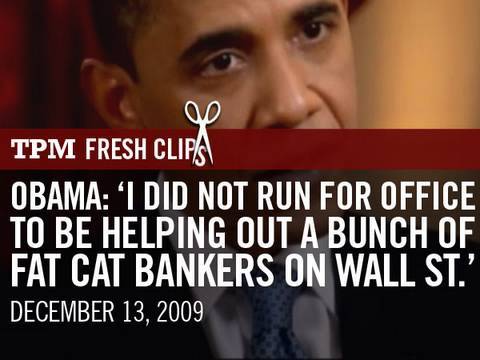
It used to be said that patriotism was the last refuge of scoundrels. Now that patriotism is being viewed with more irony than honor among a certain portion of Americans, I think the “last refuge” has become the bashing of “fat cats.” My evidence is a recent spate of articles on how President Obama, who is polling rather poorly these days, is once again going after Wall Street bonuses. There is no surer way to get heads nodding again when you speak.
I nod, too, but for a different reason. I continue to be astounded by the idea that banks had been managing the well-understood “trader’s option” problem for decades, then suddenly lost the ability to do so in the mid-2000s, and crash goes the financial system. This explanation simply doesn’t hold water. Neither does the idea that bankers suddenly became “greedy” in the mid-2000s, and crash went the financial system. No. If one wishes to develop a cogent theory about “what went wrong,” one must identify distinguishing characteristics, not common, long-imbedded ones.
I can (and have) provided many reasons why the “bonus culture” of banks has been unfairly blamed for the financial crisis. Fahlenbrach and Stulz (http://papers.ssrn.com/sol3/papers.cfm?abstract_id=1439859) provided the best empirical evidence that it didn’t.
Now, a new paper by legal scholars Whitehead and Sepe basically blames competition for talent as undermining proper incentives. I salute them for at least acknowledging the competition for talent in banking. Most critics of the banking system were feverishly trying to outdo each other in how firmly they would cap banker pay in arbitrary ways at arbitrary levels without regard to the competitive issues that such rules would create in order to “solve the problem” that they claimed was at the heart of the financial crisis. The ensuing exodus of talent at large, public U.S. banks has been unbelievable. (Literally–people outside of the industry don’t believe me when I tell them how bad it has been. The more polemical critics simply roll their eyes and smugly say, “Yeah, the talent to blow up the economy. Good riddance.”) Whitehead and Sepe acknowledge the competitiveness issue, but then go on to recommend arbitrary limits on how bankers may move from one firm to another.
If you believe that you have to compete for talent in financial services, including traders, and if you understand that different forms of pay offer different expected value to potential employees, then one can readily see that the only way to increase the risk and constraints of banker pay while acknowledging the need to compete for their talents would be to increase the expected value of that constrained, riskier pay package. Partnerships do this all the time. They create very risky, very constrained pay packages, and manage to lure incredible talent. Hedge funds didn’t contribute to the financial crisis, and didn’t need to get bailed out. And no one is suggesting that we need to limit how hedge fund employees move from one firm to another in order to moderate or contain risky behavior. What makes this work is that hedge funds don’t have to disclose how much their successful people earn.
How little President Obama and his staff know about these issues may or may not shock you. But he doesn’t have to know anything about the economics and dynamics of incentive compensation in the financial sector, or any sector. He just has to know the math: “Bashing Wall Street” = “Higher poll numbers.”
Posted by Marc Hodak on December 2, 2013 under Governance, Politics |

New SEC Chairpersons tend to bring along new priorities. Mary Shapiro, former FINRA regulator, brought a strong regulatory agenda. Mary Jo White, former United States Attorney, is bringing a strong prosecutorial agenda. This shift in priorities appears to have manifested itself in a new Rule List that, at least for now, drops the push for disclosure of corporate political contributions. The pro-regulatory crowd is not going to be happy.
Corporate political spending has been a hot topic since Citizens United in 2010. This ruling gave corporations and unions the ability to spend without limit on political ads, as long as they did not directly contribute to a candidate’s campaign. The people pushing hardest for corporate disclosure of such spending have—no surprise—been those most opposed the policies that corporations are most likely to promote, e.g., less regulation, lower taxes, and reduced trade barriers.
Of course, these political opponents aren’t going to argue that corporate America should not spend money on politics just because they oppose their policies. Americans won’t accept selective application of First Amendment rights. Instead, these opponents have taken a subtler tack, arguing that good governance requires greater transparency.
Read more of this article »
Posted by Marc Hodak on September 22, 2013 under Executive compensation, Politics, Stupid laws, Unintended consequences |
The SEC has finally proposed a rule on the infamous “CEO Pay ratio,” i.e., the ratio of CEO pay to that of the median worker. There has been plenty of debate about the pros and cons of this requirement. The primary criticism is that this ratio will not pass any cost/benefit analysis. Every company knows this is true. Most institutional investors know it, too, and don’t really care for this rule. In fact, the only people likely to benefit from this rule are the unions that pushed for it. Even their benefit is speculative since the unintended consequences of this rule are difficult to fully predict. For instance, it might encourage further outsourcing of relatively low-wage work to foreign companies, depressing employment. In other words, we could very well see the average pay of the median worker go up, but only if you don’t count the zero wages being earned by those who are laid off as a result of this law.
Given how dubious are the benefits of this rule, let’s turn to the costs. I have seen estimates of calculating this ratio for a large, multinational firm as high as $7.6 million. Being in the advisory business, that seems pretty excessive to me. By comparison, the average cost of complying with the dreaded SOX Section 404 was about $2 to $3 million for the typical company (which was about 10 times higher than the SEC estimated it would cost when they published its rules).
So, let’s say it costs about $2 to $3 million for a large company, which is a reasonable estimate for a multinational given the way the rules look right now. Well, about 10 percent of Fortune 500 CEOs made less than that in 2012. That’s right, we are almost certain to see quite a few companies paying more than they actually pay their CEO to figure out how much more their CEO makes than their median worker.
If this rule was really being implemented for the benefit of the shareholders, then Congress could have let each company’s shareholders opt in or opt out of this disclosure regime. Clearly, the people pushing this ratio had no interest in giving actual shareholders a veto over this racket.
Posted by Marc Hodak on July 13, 2012 under Governance, Politics |
Citizens United unleashed a firestorm of controversy and apocalyptic visions of corporations spending “unlimited” amounts of money on political campaigns. I was on a panel recently debating the governance issues related to corporate political spending. One of the arguments against it went like this:
- Such spending would invariably be proposed and executed by management. As such, it is likely to be guided by the personal preferences top management, especially the CEO.
- There is a good chance that the political preferences of management may not coincide with the best interests of the company (i.e., an agency problem).
- Furthermore, such spending is guaranteed to offend the sensibilities of significant portion of not only a diverse shareholder base, but of employees and customers as well, and that can’t be good for the company.
- Therefore, corporate political spending–although allowed as a matter of law–should still be discouraged, if not banned, by boards and investors as a matter of good governance, if not public decency.
This point was raised by both my fellow panelists and members of the audience. The audience was largely anti-corporate, and frankly willing to accept any excuse to prevent corporations from exercising any influence on the political arena. That is probably why my retort seemed to cause nothing but a hush in the crowd. That retort was:
- Agency is inherent in all organizations.
- For example, the non-partisan Center for Responsive Politics says that about 92 percent of union contributions go to Democratic candidates. Yet, about 38 percent of union members vote for Republican candidates.
- AARP, Sierra Club, and all kinds of broad-membership non-profits have similar agency issues.
I don’t point this out to suggest that unions or anyone else should be prevented from spending on politics, but to suggest that the existence of agency is not per se a reason to prevent one kind of organization from indulging in such spending when all other kinds of organizations, suffering from the same agency issues, are considered OK for such spending.
For the record, I believe that union leaders are probably as conscientious in allocating their political pelf in a manner that supports their organizational interests as corporate leaders are be about allocating theirs. The main difference between union and corporate spending is how lopsidedly different they are in their support for parties and candidates. Unions are remarkably monolithic in their support or “liberal” or “progressive” causes. Corporations, in contrast, ironically follow the Obama prescription, and spread the wealth around, giving about equally to both parties.
